 TokenSave
The Cheapest LLM APIs in 2026, Ranked by Real Cost per Request
Jonhisking · October 6, 2026
If you only need the lowest bill, the cheapest LLM API in October 2026 is GPT-5 nano, followed by GPT-6 Luna and Qwen 3.8 Flash. But the cheapest model is rarely the right one for every job. Here is every major model ranked by what a real request costs, which cheap models are worth using, and where paying more saves money.
How we ranked them
Price per million tokens is misleading on its own, for two reasons:
- Output costs 200 to 700% more than input on most models, so a model with cheap input and expensive output can lose to one with the opposite.
- Tokenizers differ. In our own test the same English text was about 38% more tokens on current Claude models than on GPT, and about the same on Gemini (dataset). A "$2 per million" Claude model costs more per request than a "$2 per million" GPT model.
So we priced one typical request: 2,000 input tokens and 500 output tokens of English, counted the way each model's tokenizer would count it, at official list prices checked October 1, 2026. No caching or batch discounts.
The cheapest LLM APIs
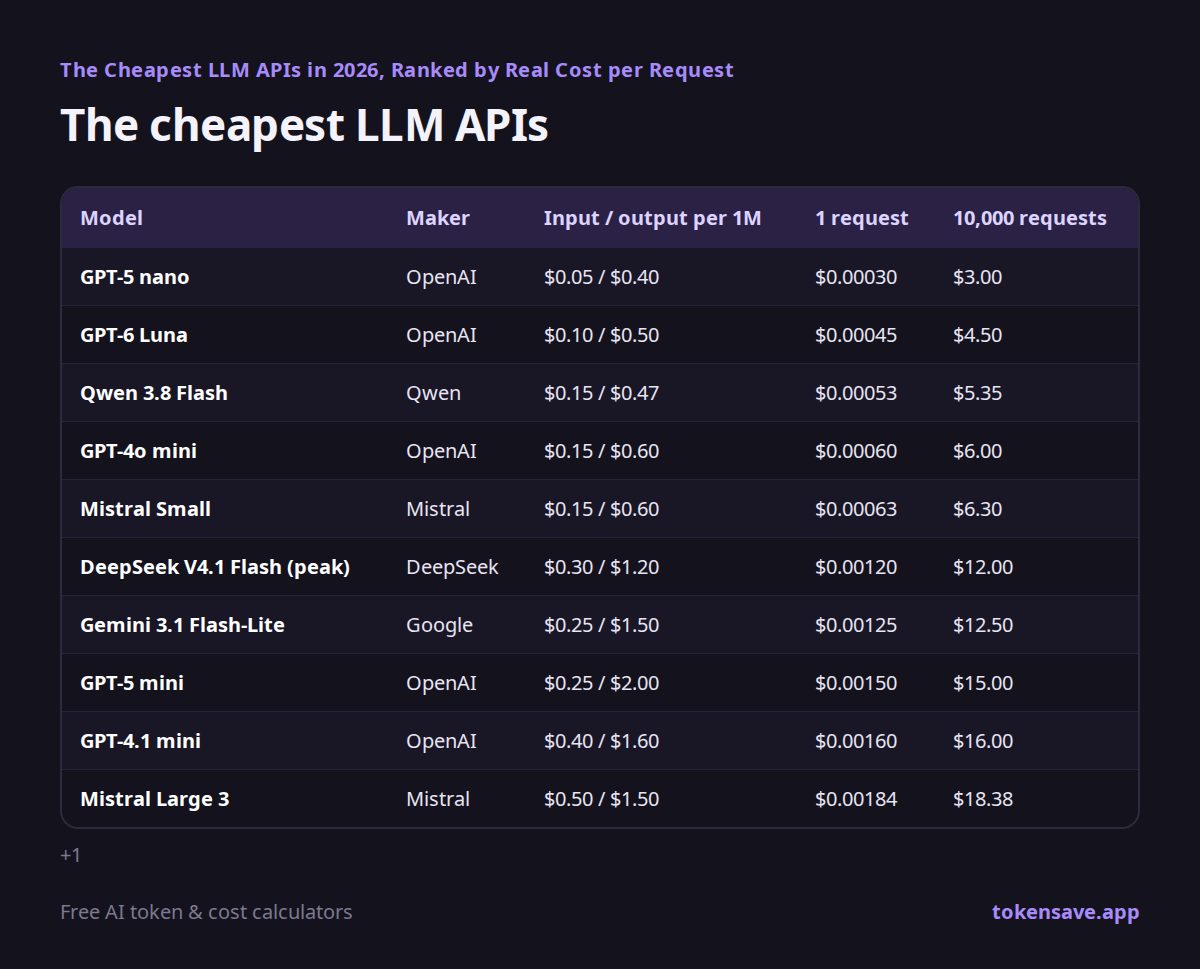
| Model | Maker | Input / output per 1M | 1 request | 10,000 requests |
|---|---|---|---|---|
| GPT-5 nano | OpenAI | $0.05 / $0.40 | $0.00030 | $3.00 |
| GPT-6 Luna | OpenAI | $0.10 / $0.50 | $0.00045 | $4.50 |
| Qwen 3.8 Flash | Qwen | $0.15 / $0.47 | $0.00053 | $5.35 |
| GPT-4o mini | OpenAI | $0.15 / $0.60 | $0.00060 | $6.00 |
| Mistral Small | Mistral | $0.15 / $0.60 | $0.00063 | $6.30 |
| DeepSeek V4.1 Flash (peak) | DeepSeek | $0.30 / $1.20 | $0.00120 | $12.00 |
| Gemini 3.1 Flash-Lite | $0.25 / $1.50 | $0.00125 | $12.50 | |
| GPT-5 mini | OpenAI | $0.25 / $2.00 | $0.00150 | $15.00 |
| GPT-4.1 mini | OpenAI | $0.40 / $1.60 | $0.00160 | $16.00 |
| Mistral Large 3 | Mistral | $0.50 / $1.50 | $0.00184 | $18.38 |
| Gemini 3.5 Flash-Lite | $0.30 / $2.50 | $0.00185 | $18.50 |
For comparison, the same 10,000 requests cost $90 on GPT-6 Sol, $124 on Claude Sonnet 5.5, $248 on Claude Opus 5.5 and $450 on GPT-6 Astra. The cheapest model in the table costs less than 1% of what GPT-6 Astra does.
Which cheap model to pick
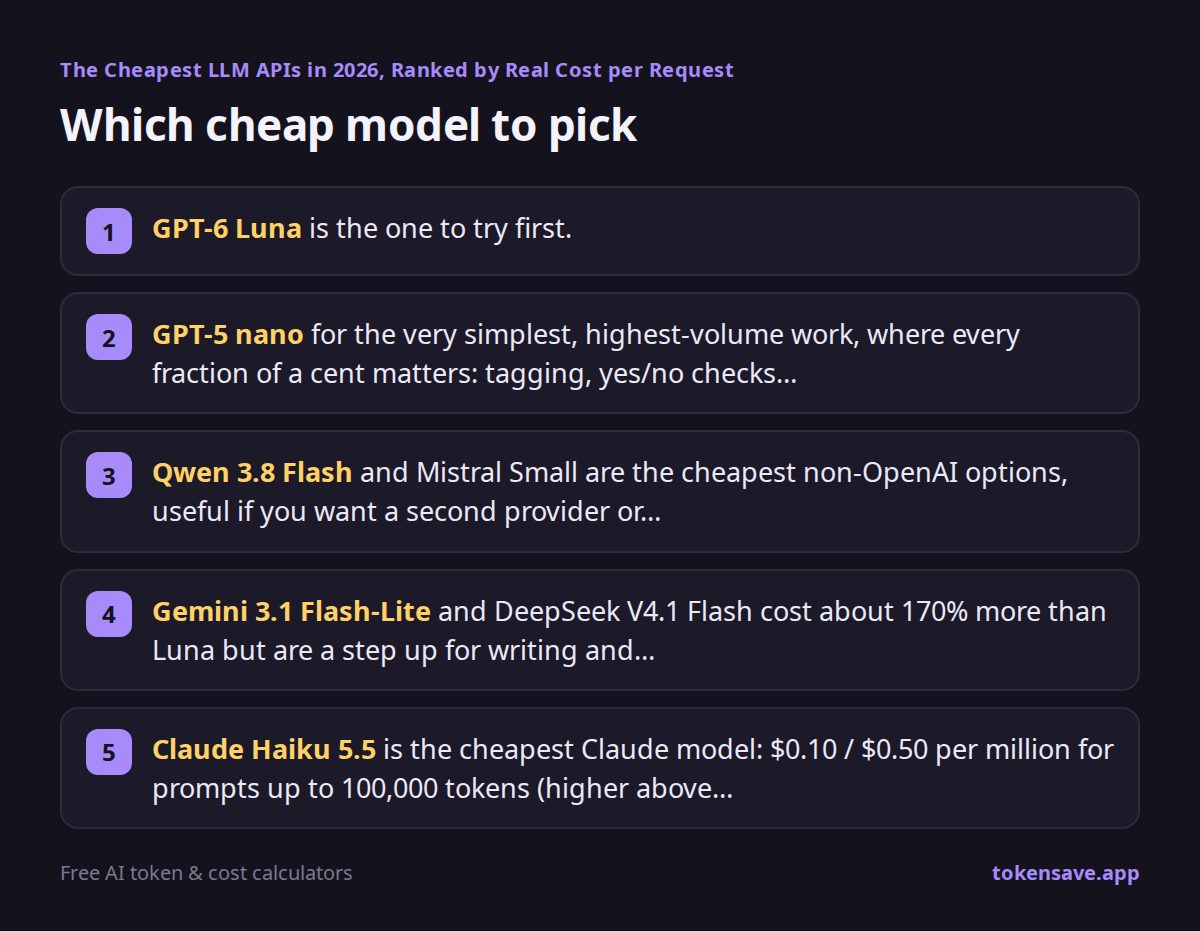
- GPT-6 Luna is the one to try first. It is the newest small model from OpenAI (September 2026), and only $1.50 per 10,000 requests more than GPT-5 nano. Good for classification, extraction, routing, short answers and summaries.
- GPT-5 nano for the very simplest, highest-volume work, where every fraction of a cent matters: tagging, yes/no checks, spam filtering.
- Qwen 3.8 Flash and Mistral Small are the cheapest non-OpenAI options, useful if you want a second provider or open-weight models you could later host yourself.
- Gemini 3.1 Flash-Lite and DeepSeek V4.1 Flash cost about 170% more than Luna but are a step up for writing and reasoning, and still about 86% cheaper than GPT-6 Sol per request. DeepSeek V4.1 Flash is half price outside peak hours ($0.15 / $0.60), which puts it right behind GPT-6 Luna; see DeepSeek V4.1 Flash pricing.
- Claude Haiku 5.5 is the cheapest Claude model: $0.10 / $0.50 per million for prompts up to 100,000 tokens (higher above that), about $0.00062 per request, around 38% more than Luna. The older Claude Haiku 4.5 ($1 / $5) costs $0.0046 per request. Pick Haiku when you need Claude's behavior specifically.
When the cheapest model costs more
A cheap model that fails costs you twice: once for the bad answer, and again for the retry on a better model, plus your time. Two patterns save more than picking the cheapest model everywhere:
- Route by difficulty. Send everything to a small model first and escalate only the requests it gets wrong (or that you flag as hard) to GPT-6 Sol, Claude Sonnet or Gemini 3.1 Pro. If 80% of requests stay on GPT-6 Luna and 20% go to GPT-6 Sol, the average cost drops by about 75% compared with sending all of them to Sol.
- Cut the tokens, not just the price. Prompt caching bills repeated instructions and documents at about a tenth of the input price on most providers, and batch APIs charge about half for work that can wait. See Prompt caching explained and Batch APIs: half-price AI.
Your language changes the ranking
All the costs above are for English. Other languages use more tokens for the same meaning: Korean about 44% more and Japanese about 79% more on GPT, so every price in the table rises by the same share. The ranking stays the same; the bill does not. See the same prompt in 41 languages.
Check your own prompt
Paste a real prompt into the token counter to see its exact token count and cost on every model, or open the OpenAI, Claude or Gemini counter. For a full side-by-side of capability against price, see AI model capability vs price.
Prices change often. Check the provider's pricing page before you commit to a model.
Sources
- OpenAI API pricing
- OpenAI: GPT-5 nano model
- Alibaba Cloud: qwen3.8-flash pricing
- Mistral AI: Mistral Large 3
- Gemini API pricing
- DeepSeek API models and pricing
- Claude API pricing
More articles
- Claude Haiku vs Opus for Coding: 330 Measured Runs
- Claude Code Cache Lasts 1 Hour: What a Break Costs (Measured)
- ChatGPT Go vs Plus: Is the $20 Plan Worth $12 More?
- AI Subscription Price Comparison: ChatGPT vs Claude vs Gemini vs Grok (2026)
- A Beginner Vibe-Codes a Game — Zero Coding, 3 Days, $45
Paste a prompt to see its tokens and cost on every GPT-6 model, Claude and Gemini.
Open the token counter →