 TokenSave
 Data · Dataset
Does being polite to AI cost more?
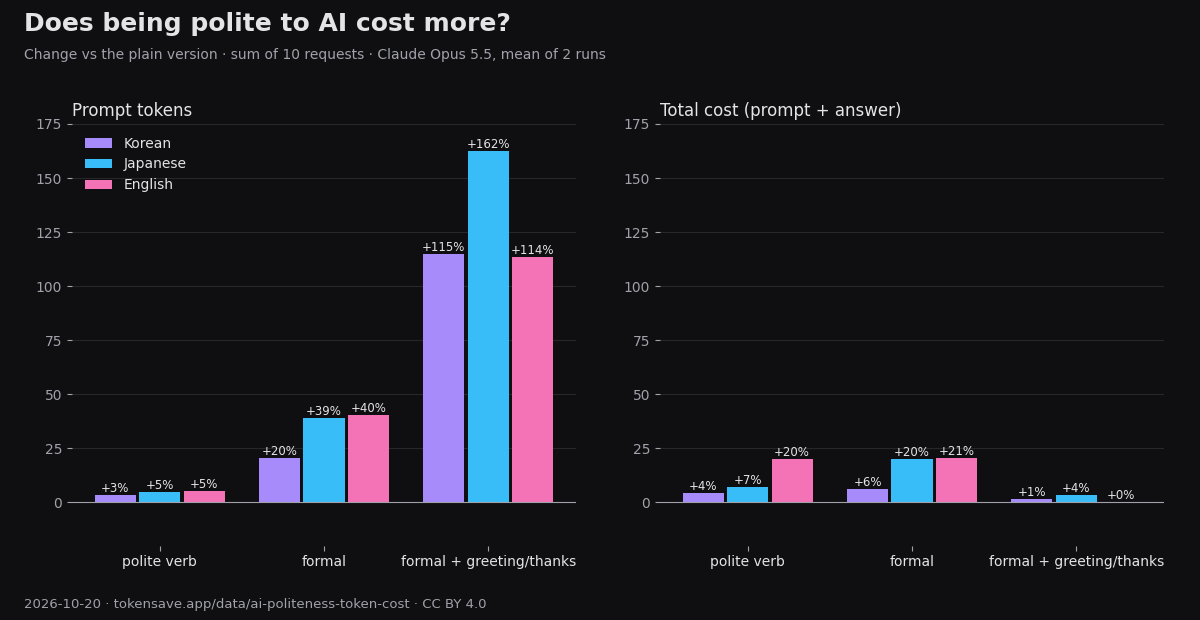
Being polite to AI more than doubles the length of your prompt, but adds only a few percent to what the message costs. Greetings, apologies and thanks raised the prompt by 115% in Korean, 162% in Japanese and 114% in English on Claude, yet the most polite version cost only 0–4% more in total, because the answer, which is most of the cost, did not get longer.
Measured 2026-10-20 · Claude Opus 5.5 and Haiku 5.5 · 3 languages × 10 requests × 4 levels · License CC BY 4.0 · Related: Language Tax Index
Key findings
- Polite padding adds a lot of prompt tokens. The most polite version of each request (greeting + apology + thanks) needed 115% more Claude tokens than the plain version in Korean, 162% more in Japanese and 114% more in English (GPT o200k: 78%, 123% and 121%). Changing only the verb ending (“해 줘” to “해 주세요”, “して” to “してください”, adding “please”) added just 3–5%.
- The answers did not grow with politeness. For the most polite version, answers were about as long as for the plain one (Korean ±0%, Japanese +2%, English -1%). The two middle levels (“please”, “Could you please …?”, “ご提案いただけますでしょうか”) did get longer answers in Japanese and English (up to +21%), but Korean was mixed and the same prompts varied by up to 19% between two runs, so this is a hint rather than a rule.
- The polite words themselves cost little. Answers are 10–20 times longer than prompts and output tokens cost five times as much, so the extra prompt tokens of the most polite version are worth about 1.1% of a message's cost on Opus 5.5. Measured totals for the most polite level against plain: Korean +1%, Japanese +4%, English ±0%. Most of any difference in cost comes from how long the answer is, not from the courtesy phrases.
- Where it does add up: text that is sent again and again. A system prompt, a template or a CLAUDE.md is resent with every request, so greetings and courtesy phrases there cost on every call. In a one-off chat message they barely register.
Results on Claude Opus 5.5
Sum of 10 requests per level, mean of two runs. Prompt tokens exclude the fixed system prompt. Cost = prompt and answer tokens at API list prices ($4 / $20 per million). Haiku 5.5 results and every single request are in the CSV.
| Language | Level | Prompt tokens (10 requests) | vs plain | Answer tokens | vs plain | Cost (Opus 5.5) | vs plain |
|---|---|---|---|---|---|---|---|
| Korean | banmal (해체) | 303 | – | 6,464 | – | $0.130 | – |
| haeyo (해요체) | 313 | +3% | 6,730 | +4% | $0.136 | +4% | |
| formal (하십시오체·주시겠어요) | 365 | +20% | 6,864 | +6% | $0.139 | +6% | |
| formal + greeting and thanks | 651 | +115% | 6,486 | ±0% | $0.132 | +1% | |
| Japanese | plain (普通体) | 236 | – | 5,672 | – | $0.114 | – |
| desu/masu (丁寧語) | 247 | +5% | 6,082 | +7% | $0.123 | +7% | |
| keigo (尊敬語・謙譲語) | 328 | +39% | 6,796 | +20% | $0.137 | +20% | |
| keigo + greeting and thanks | 619 | +162% | 5,800 | +2% | $0.118 | +4% | |
| English | plain imperative | 198 | – | 4,486 | – | $0.091 | – |
| please | 208 | +5% | 5,387 | +20% | $0.109 | +20% | |
| could you please + thank you | 278 | +40% | 5,408 | +21% | $0.109 | +21% | |
| greeting + apology + thanks | 423 | +114% | 4,450 | -1% | $0.091 | ±0% |
The four levels
- Korean: 반말 (“추천해 줘”), 해요체 (“추천해 주세요”), formal (“추천해 주시겠습니까?”), formal with “안녕하세요! 바쁘신데 죄송하지만 … 감사합니다”.
- Japanese: 普通体 (“考えて”), です・ます (“考えてください”), 敬語 (“ご提案いただけますでしょうか”), 敬語 with “お疲れ様です。お忙しいところ恐縮ですが … よろしくお願いいたします”.
- English: plain (“Suggest”), “Please suggest”, “Could you please …? Thank you.”, and “Hi! Sorry to bother you, but could you please …? Thanks so much!”.
Method
- 10 everyday requests (email subject lines, a Python question, a date plan, a translation, a template, Excel help, blog titles, a self-introduction, a spelling fix, work-from-home tips), each written at four politeness levels in three languages: 120 prompts. All prompts are in the downloads.
- Each prompt sent once per run to Claude Code 2.1.295 as a plain chat:
claude -p --system-prompt "You are a helpful assistant." --tools "", no MCP servers. Opus 5.5 twice, Haiku 5.5 once, on 2026-10-20. Prompt tokens = the run's input tokens minus a one-character baseline run. - GPT token counts with js-tiktoken (o200k_base and cl100k_base).
Limitations
- One-turn chats. In a long conversation every earlier message is sent again, so polite phrases in it are paid for repeatedly, though they stay small next to the answers.
- Answer length varies a lot from run to run; two runs on Opus and one on Haiku cannot rule out a small effect of politeness on the answers.
- We do not measure whether politeness changes answer quality.
How to cite
Free to use, quote and republish with attribution under CC BY 4.0. Please link to this page.
TokenSave (2026). Does being polite to AI cost more? Plain, polite and very polite prompts in Korean, Japanese and English [Data set]. https://tokensave.app/data/ai-politeness-token-cost
Embed the chart
Related
Questions or corrections: contact@jonhisking.com