 TokenSave
TokenSave Data · Dataset
How many more tokens each language needs than English
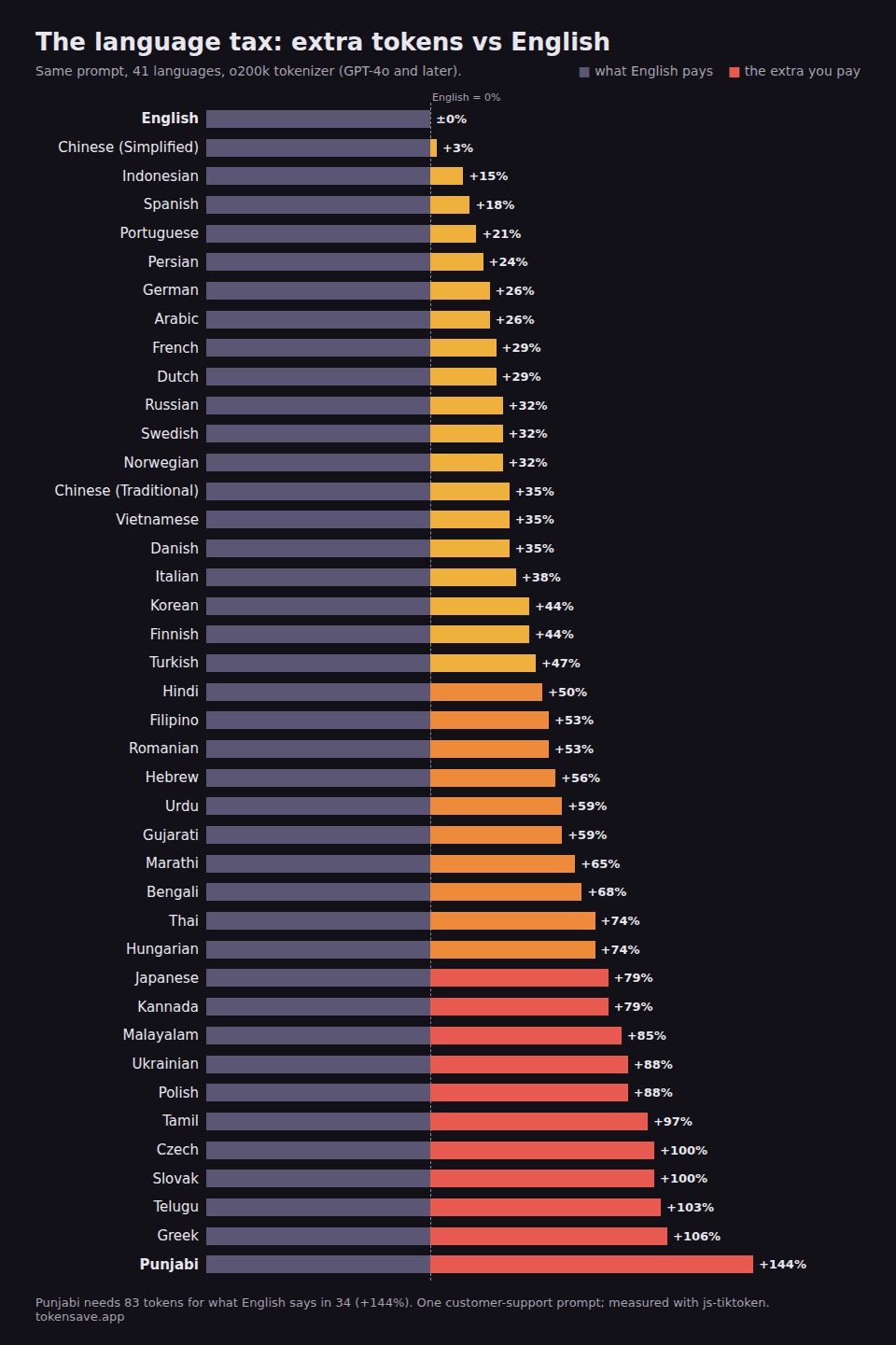
The same prompt needs 34 GPT tokens in English and 35–83 tokens in 40 other languages: from +3% (Simplified Chinese) to +144% (Punjabi). Korean needs +44%, Japanese +79%, Spanish +18% and German +26%.
Tokenizer: o200k_base (GPT-4o and later), with cl100k_base (GPT-4, GPT-3.5) for comparison · Measured 2026-09-30 · Counts re-verified 2026-10-16 · License CC BY 4.0
Why it matters
API prices are per token, so a language that needs +44% more tokens pays about +44% more for the same request. Usage limits on ChatGPT, Claude and Gemini plans are also counted in tokens, so the same gap shows up as messages running out sooner. If the model answers in the same language, the output costs more too, and output tokens are usually priced 300–400% higher than input.
All 41 languages
| Language | o200k tokens | vs English | cl100k tokens | vs English |
|---|---|---|---|---|
| English | 34 | ±0% | 34 | ±0% |
| Chinese (Simplified) | 35 | +3% | 52 | +53% |
| Indonesian | 39 | +15% | 47 | +38% |
| Spanish | 40 | +18% | 44 | +29% |
| Portuguese | 41 | +21% | 48 | +41% |
| Persian | 42 | +24% | 95 | +179% |
| German | 43 | +26% | 51 | +50% |
| Arabic | 43 | +26% | 103 | +203% |
| French | 44 | +29% | 49 | +44% |
| Dutch | 44 | +29% | 59 | +74% |
| Swedish | 45 | +32% | 51 | +50% |
| Norwegian | 45 | +32% | 53 | +56% |
| Russian | 45 | +32% | 73 | +115% |
| Danish | 46 | +35% | 54 | +59% |
| Chinese (Traditional) | 46 | +35% | 72 | +112% |
| Vietnamese | 46 | +35% | 79 | +132% |
| Italian | 47 | +38% | 54 | +59% |
| Finnish | 49 | +44% | 69 | +103% |
| Korean | 49 | +44% | 85 | +150% |
| Turkish | 50 | +47% | 70 | +106% |
| Hindi | 51 | +50% | 156 | +359% |
| Filipino | 52 | +53% | 60 | +76% |
| Romanian | 52 | +53% | 60 | +76% |
| Hebrew | 53 | +56% | 128 | +276% |
| Urdu | 54 | +59% | 144 | +324% |
| Gujarati | 54 | +59% | 244 | +618% |
| Marathi | 56 | +65% | 167 | +391% |
| Bengali | 57 | +68% | 207 | +509% |
| Hungarian | 59 | +74% | 77 | +126% |
| Thai | 59 | +74% | 126 | +271% |
| Japanese | 61 | +79% | 75 | +121% |
| Kannada | 61 | +79% | 318 | +835% |
| Malayalam | 63 | +85% | 343 | +909% |
| Polish | 64 | +88% | 72 | +112% |
| Ukrainian | 64 | +88% | 107 | +215% |
| Tamil | 67 | +97% | 288 | +747% |
| Slovak | 68 | +100% | 86 | +153% |
| Czech | 68 | +100% | 88 | +159% |
| Telugu | 69 | +103% | 319 | +838% |
| Greek | 70 | +106% | 168 | +394% |
| Punjabi | 83 | +144% | 252 | +641% |
The newer o200k tokenizer narrowed the gap for most languages; the older cl100k column shows how much. For example, Korean went from +150% to +44% and Hindi from +359% to +50%.
Method
- One everyday English prompt: “Please summarize the customer email below in three bullet points and suggest a polite reply. The customer says the order arrived two days late and one item was missing from the box.”
- Translated into each language (machine translation as a first draft, then checked) and counted with OpenAI's tiktoken using
o200k_baseandcl100k_base. - “vs English” = tokens in the language ÷ English tokens − 1, rounded to whole percent. Every translated prompt is in the CSV, so the counts can be reproduced.
Limitations
- One prompt. With other text the ratios move by roughly ±10–20 percentage points; the ranking is more stable than the exact numbers.
- OpenAI tokenizers only. Claude and Gemini use their own tokenizers, so their gaps differ (see our Claude Korean test).
- Input text only. It does not measure how long the model's answer would be in each language.
How to cite
Free to use, quote and republish with attribution under CC BY 4.0. Please link to this page.
TokenSave (2026). Token cost by language: 41 languages measured on GPT tokenizers [Data set]. https://tokensave.app/data/token-cost-by-language
Embed the chart
Related
- Full write-up: why some languages cost more and how to save
- Per-language articles (41 languages)
- Count tokens for your own text · Tokens to words converter
Questions or corrections: contact@jonhisking.com