 TokenSave
 Data · Dataset
Same code, about 60% more output tokens: Claude vs GPT vs Gemini in four coding tools and five languages
To write the same kind of game, Claude Opus 5.5 spent about 60% more output tokens per character of code than Gemini 4 Argon, and about 57% more than GPT. Opus came out the same in Claude Code (591 tokens per 1,000 characters) and in Google’s Antigravity CLI (596), so it is the model’s tokenizer, not the tool. Writing the prompt in Korean, Japanese, Spanish or Ukrainian instead of English changed input tokens by only a few percent.
Measured 2026-10-18 to 2026-10-23 · 80 runs · Claude Code 2.1.295, Codex CLI 0.162, Antigravity CLI 1.4.5 · License CC BY 4.0
DOI 10.5281/zenodo.23585139 · Also on Hugging Face · Kaggle · GitHub
Count the tokens in your own text → Paste your prompt and see tokens, characters and API cost on GPT, Claude and Gemini. Free and private: it runs in your browser.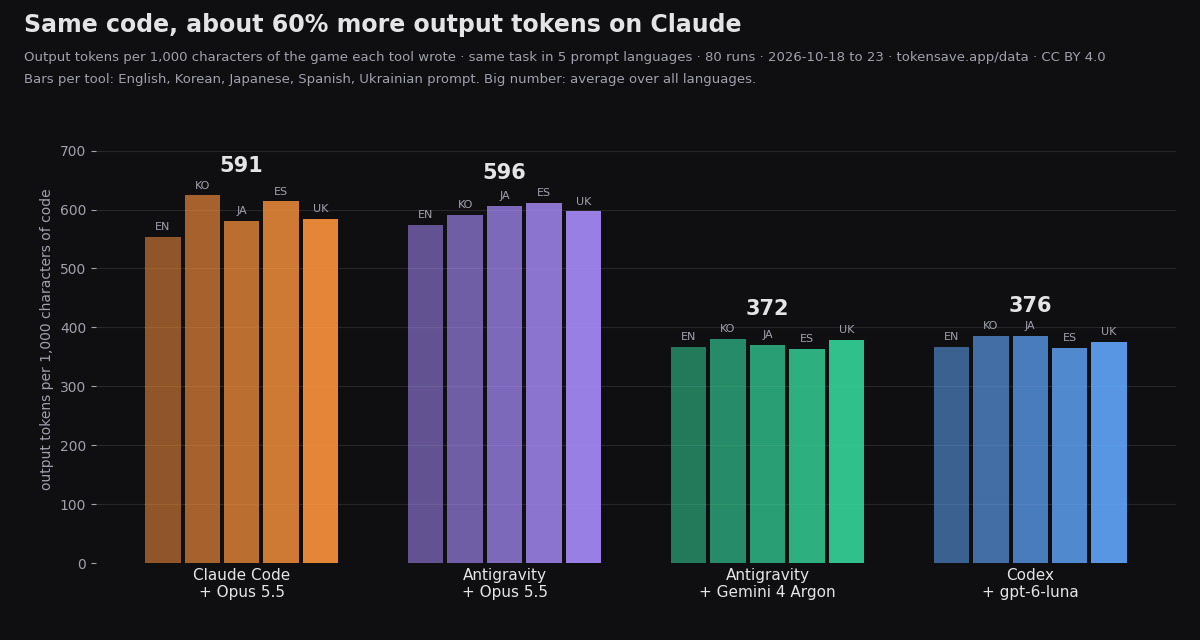
Key findings
- Output tokens per 1,000 characters of game code: Opus 5.5 591 in Claude Code and 596 in Antigravity, Gemini 4 Argon 372, gpt-6-luna 376 in Codex. The range across the five prompt languages was narrow for every model (Opus 554 to 624, Gemini 364 to 380, GPT 366 to 386).
- Why it matters: output tokens are the expensive ones (Opus 5.5 charges five times more for output than for input), and because the gap is per character, it comes on top of any difference in how long each model’s game turned out. It matches the direction of our earlier tokenizer test, where the same source code needed 43% to 59% more Claude tokens than GPT tokens.
- Prompt language barely moved input tokens. Inside each tool the five languages stayed within a few percent; the tool decided the size: about 78,638 input tokens in Claude Code, 48,538 in Codex and 11,316 to 13,289 in Antigravity for the Korean prompt. Most of every request is the tool’s own instructions.
- Opus wrote longer games in Korean and Ukrainian in Antigravity (10,004 and 9,173 characters against 7,627 in English), so its total output rose there, but per character it stayed the same.
- 79 of 80 games worked (score rises, level 2 appears, lives go 3, 2, 1, 0), and every game showed its text in the prompt language. The one failure is a Codex game from the earlier dataset.
Output tokens per 1,000 characters of code
Output tokens reported by each tool divided by the characters of the index.html it wrote. Average of 5 runs (Claude Code, Codex) or 3 runs (Antigravity) per language.
| Tool + model | English | Korean | Japanese | Spanish | Ukrainian |
|---|---|---|---|---|---|
| Claude Code + Opus 5.5 | 554 | 624 | 581 | 614 | 584 |
| Antigravity + Opus 5.5 | 574 | 590 | 606 | 612 | 597 |
| Antigravity + Gemini 4 Argon | 367 | 380 | 370 | 364 | 378 |
| Codex + gpt-6-luna | 367 | 386 | 385 | 366 | 376 |
Input tokens by prompt language
Claude Code: input + cache creation + cache read. Codex: input including cached. Antigravity: its reported input_tokens (cache reads are reported separately and are in the CSV). Claude Code’s English average includes two runs from 2026-10-18 that took an extra step.
| Tool + model | English | Korean | Japanese | Spanish | Ukrainian |
|---|---|---|---|---|---|
| Claude Code + Opus 5.5 | 96,462 | 78,638 | 79,266 | 79,030 | 79,787 |
| Antigravity + Opus 5.5 | 9,822 | 11,316 | 9,983 | 9,945 | 10,958 |
| Antigravity + Gemini 4 Argon | 13,041 | 13,289 | 12,408 | 12,629 | 13,447 |
| Codex + gpt-6-luna | 51,674 | 48,538 | 48,660 | 48,201 | 48,816 |
Method
- Task: “Make a brick-breaker game that runs in the browser as a single file named index.html … 2 levels, a score display and 3 lives … keyboard and mouse”, translated into Korean, Japanese, Spanish and Ukrainian. Medium effort everywhere, each run in its own empty folder on Windows 11.
- Claude Code 2.1.295 and Codex CLI 0.162: the 50 runs of our prompt-language dataset (2026-10-18 and 19). Antigravity CLI 1.4.5: English from our three-way comparison (2026-10-22) and 24 new runs in the other four languages (2026-10-23).
- Every game was played in headless Chromium by a script that watches the score, the level and the lives; the check reads the game’s own text in all five languages.
Limitations
- Output tokens include the short final reply and the tool-call wrapping around the file, not only the code. Antigravity reported no or few thinking tokens; Claude Code and Codex count any reasoning inside their output figure.
- One task (a browser game in HTML, CSS and JavaScript). Other kinds of code may tokenize differently.
- 3 to 5 runs per cell, measured over six days with the same tool versions.
How to cite
Free to use, quote and republish with attribution under CC BY 4.0. Please link to this page.
TokenSave (2026). Same code, about 60% more output tokens: Claude vs GPT vs Gemini in four coding tools and five languages [Data set]. Zenodo. https://doi.org/10.5281/zenodo.23585139
Embed the chart
Related
- Antigravity CLI vs Claude Code vs Codex
- Does prompt language change AI coding cost?
- Token cost by programming language
- Count tokens for your own text
Questions or corrections: contact@jonhisking.com