 TokenSave
 Data · Dataset
How many tokens does Blender MCP cost? 72 Claude Code runs, and a racing scene for $0.47
Blender MCP is lighter than its reputation. Everyday tasks in Claude Code cost $0.16 to $0.23 each, and a racing car with a circuit and a 5-second chase-camera animation cost $0.47. The expensive case is a long script output: printing every property of 580 objects cost $0.87, and $0.17 (-81%) through our open-source tokensave-mcp-diet proxy. Elsewhere the proxy saved little.
Measured 2026-10-22 · 72 runs · Claude Code 2.1.295, Opus 5.5, Blender 5.2.2 · License CC BY 4.0 · Tool: tokensave-mcp-diet · Related: Browser MCP token cost
DOI 10.5281/zenodo.23562484 · Also on Hugging Face · Kaggle · GitHub · GitHub (tokensave-mcp-diet)
Estimate your own Claude Code or Codex bill → See the monthly cost of Claude Code and Codex for your usage: API per task vs Claude and ChatGPT plans. Free, no sign-up.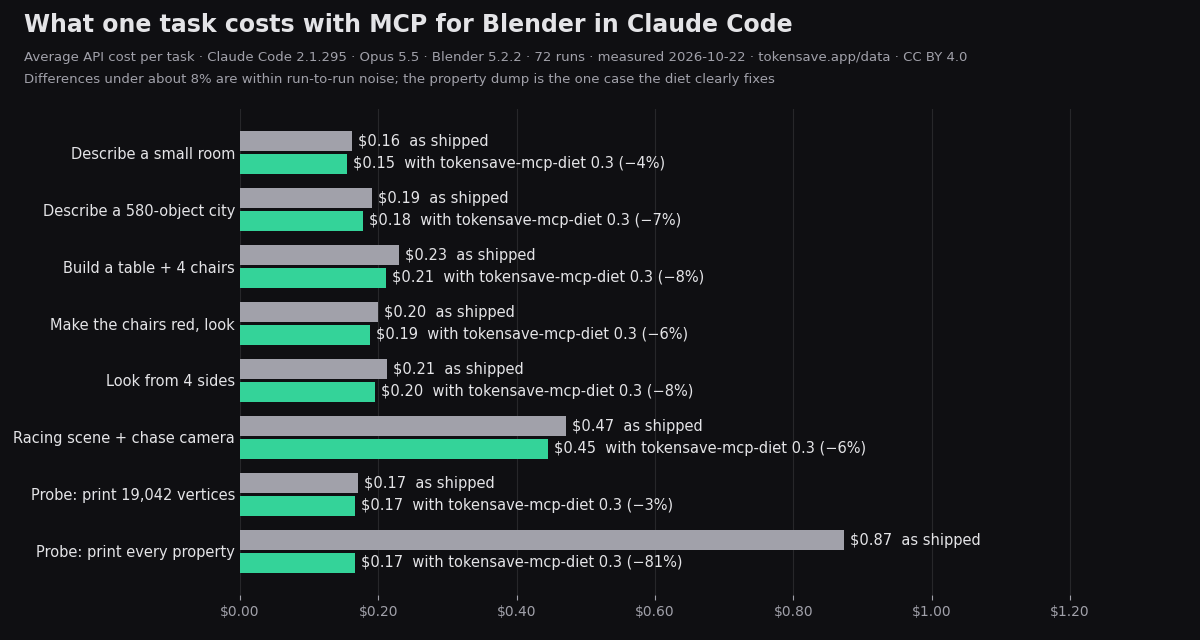
Key findings
- Everyday tasks were cheap. Describing a scene, building a table with four chairs, recolouring the chairs and checking them with a screenshot took 69,000 to 126,000 input tokens per task. The largest text result in 25 everyday runs was 2,347 characters: the current MCP for Blender already returns short summaries (20 objects per call by default) and 768-pixel images. Each request carried about 24,916 tokens, most of it Claude Code’s own instructions.
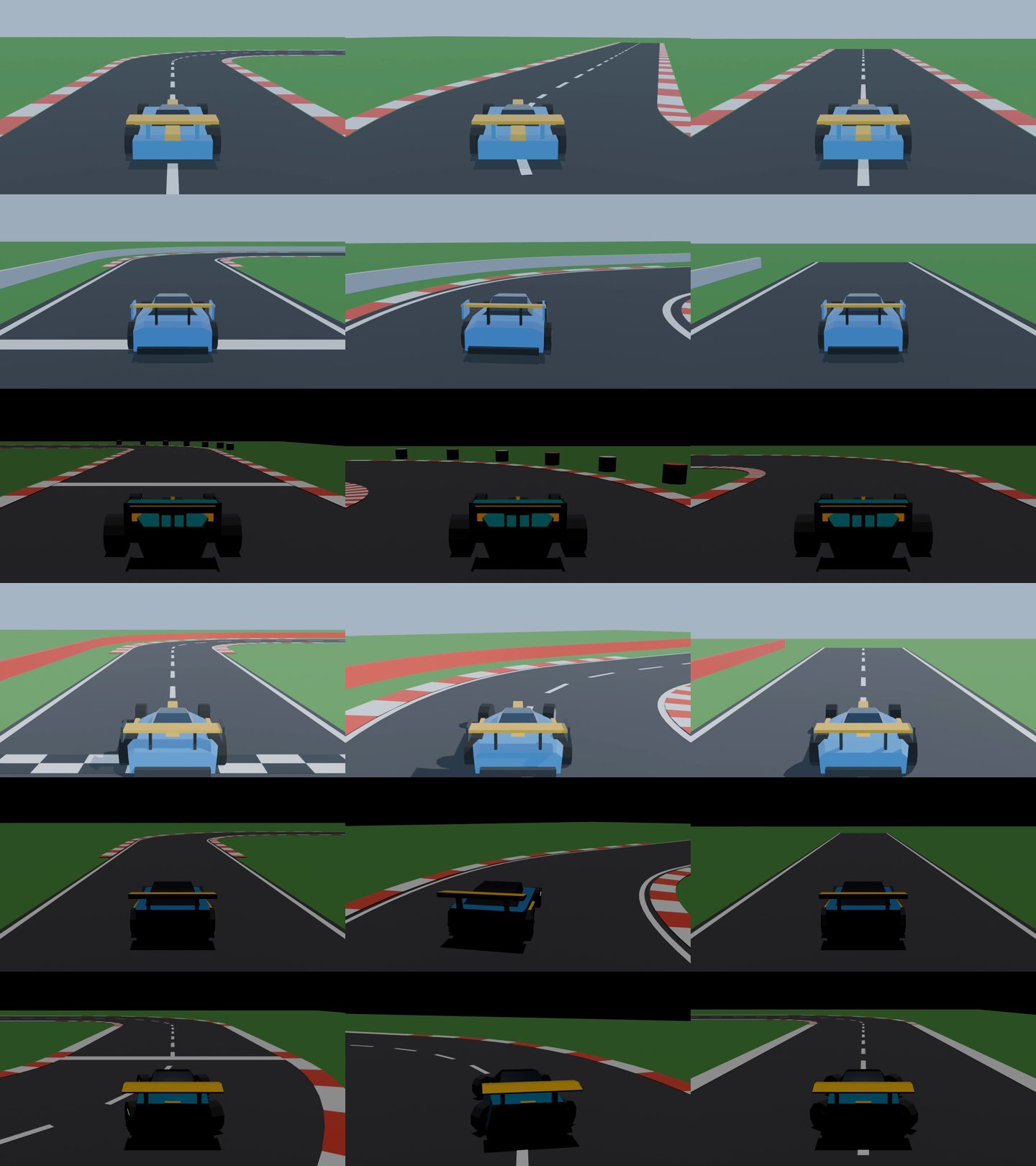
- A racing scene cost about $0.47. Claude built a low-poly car of its own design and a circuit with a corner, animated the car over 120 frames and added a chase camera, in 9.6 requests and about 93 seconds on average. All 10 runs produced a working animation.
- The expensive case is a long script output. Asked to print every property of 580 objects, the script returned 122,373 characters. Claude Code refused it as too large; Claude then re-ran it in four chunks of about 32,000 characters, and all of them stayed in the context: 242,782 input tokens and $0.87, more than four times an everyday task.
- tokensave-mcp-diet 0.3 cut that case by 81%. It keeps the first 2,000 and last 1,000 characters of any text result over 8,000, describes the hidden lines (“568 lines like: name=Building ## | type=MESH | location=(#, #, #) ...”) and lets the model read any part with a new
result_detailtool. The task cost $0.16 to $0.17 in its three runs. - Elsewhere the proxy changed little, and we say so. It also asks for 512-pixel images by default, which cut image tokens by 62% on the racing scene, but images were a small share of the input, so the scene cost 6% less (5 runs each, within run-to-run noise). The small-room description, where the proxy changed nothing, came out 4% cheaper too, so treat differences under about 8% as noise.
- Every task passed its check in 72 of 72 runs (read back from the saved .blend file: names, colours, frame range, camera, engine).
All tasks, with and without tokensave-mcp-diet 0.3
Averages. Input = all input tokens of the task (uncached + cache read + cache write). Cost at Opus 5.5 API prices as reported by Claude Code, lowest and highest run in brackets. Image tokens estimated as width × height / 750 for every image returned. Largest text result is from the runs without the diet.
| Task | Runs (base + diet) | Input tokens, as shipped | With the diet | Cost, as shipped | With the diet | Change | Largest text result (chars) | Image tokens (est.) |
|---|---|---|---|---|---|---|---|---|
| Describe a small room (13 objects) | 5 + 5 | 69,606 | 67,418 | $0.162 ($0.16–$0.16) | $0.155 ($0.15–$0.16) | -4% | 1,410 | 0 → 0 |
| Describe a city block (580 objects) | 5 + 5 | 115,868 | 97,571 | $0.190 ($0.18–$0.21) | $0.177 ($0.17–$0.19) | -7% | 2,347 | 0 → 0 |
| Build a table and four chairs | 5 + 5 | 125,563 | 109,540 | $0.230 ($0.22–$0.24) | $0.211 ($0.19–$0.23) | -8% | 342 | 176 → 70 |
| Make the chairs red, then look | 5 + 5 | 124,649 | 120,846 | $0.200 ($0.20–$0.21) | $0.188 ($0.19–$0.19) | -6% | 996 | 307 → 197 |
| Look at the table from four sides | 5 + 5 | 112,118 | 112,180 | $0.212 ($0.19–$0.27) | $0.195 ($0.18–$0.23) | -8% | 1,028 | 1,322 → 638 |
| Probe: print every vertex (19,042) | 3 + 3 | 91,572 | 83,087 | $0.171 ($0.17–$0.17) | $0.166 ($0.16–$0.17) | -3% | 1,508 | 0 → 0 |
| Probe: print every property of 580 objects | 3 + 3 | 242,782 | 67,965 | $0.873 ($0.84–$0.89) | $0.166 ($0.16–$0.17) | -81% | 34,921 | 0 → 0 |
| Showcase: racing car, circuit, 5 s chase camera | 5 + 5 | 293,329 | 261,265 | $0.471 ($0.42–$0.56) | $0.445 ($0.41–$0.51) | -6% | 427 | 1,301 → 497 |
What tokensave-mcp-diet 0.3 does for Blender
The proxy (github.com/johnisking/tokensave-mcp-diet, MIT) sits in front of MCP for Blender and passes every tool through. Version 0.3 adds three things: long text results (over 8,000 characters) keep their head and tail plus a summary of the hidden lines, with the full text available through result_detail; tools with a max_size get 512-pixel images unless the model asks for more than 1,000; and an optional --drop-user-prompt flag removes the server’s user_prompt argument (used for its opt-in telemetry), which Claude filled with about 4,384 characters per racing-scene run. That flag was off in these runs. Install: npx -y github:johnisking/tokensave-mcp-diet -- uvx mcp-for-blender.
One bug surfaced during the runs: MCP for Blender also sends each result as structuredContent, and Claude Code shows that instead of the text, so the first diet runs of the two probes were not shortened. Version 0.3 now shortens those fields too, and the probe runs were repeated after the fix in fresh working directories.
Method
- Claude Code 2.1.295,
claude -p <prompt> --effort medium --output-format stream-json --verbose, model Opus 5.5, Windows 11 with a GTX 1650, on 2026-10-22. Only the Blender MCP server was attached (--strict-mcp-config); web, file and shell tools were disabled, and so were the server’s 3D-generation and asset-download tools. - Blender 5.2.2 LTS with the window open (screenshots need it); MCP for Blender via
uvx mcp-for-blender, add-on 1.8, telemetry off. A fresh copy of the scene was opened for every run, and every run had its own working directory. - Scenes were generated by our own script, so they are identical in every run and contain no third-party assets: a room with 13 objects, a city block with 580 objects including a 19,042-vertex sphere, and an empty scene with a camera and a light.
- After each run the scene was saved and checked headlessly: the named table and chairs, the chair colours, the frame range, the scene camera and its animation, the render engine and the resolution. The racing scenes were rendered afterwards, outside the measured runs.
- Everyday tasks and the racing scene ran 5 times per mode, the two probes 3 times.
Limitations
- One model, one machine, one client (Claude Code). Clients that do not refuse large results would take in all 122,000 characters of the property dump at once.
- Costs vary from run to run (racing scene: $0.42 to $0.56 without the diet), because Claude takes a different number of steps each time.
- Image tokens are an estimate from the image size; the input totals are exact.
- MCP for Blender changes quickly; these results are for the version of 2026-10-22, which already keeps most results small.
How to cite
Free to use, quote and republish with attribution under CC BY 4.0. Please link to this page.
TokenSave (2026). Blender MCP token cost: 72 Claude Code runs, from a table and chairs to a racing scene [Data set]. Zenodo. https://doi.org/10.5281/zenodo.23562484
Embed the chart
Related
- Browser MCP token cost
- Claude Code vs Codex: startup tokens and MCP tools
- What the Claude Code harness costs
Questions or corrections: contact@jonhisking.com